Gear Ratio Calculator
Enter your tire size, gear ratio, and transmission — see engine RPM at highway speed and recommended gear ratio for your tire size.
All data stays in your browser — we never see it.
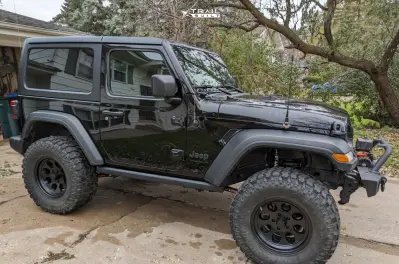
Matt had a JLU with the 3.6L Pentastar, 8-speed automatic, and 3.45 gears. Stock tires were 255/70R18 – about 32 inches. I told him to plug his numbers into the calculator. He saw that at 70 mph with stock tires, his engine was spinning about 2,100 RPM. With 35-inch tires, the RPM dropped to about 1,900. That’s below the engine’s powerband. The transmission would have to downshift constantly to maintain speed on hills. His fuel economy would drop from 20 to about 15. He wasn’t happy. “Can I just re-gear?” he asked. I told him yes. The calculator showed that he needed 4.56 gears to get back to the stock RPM range. That’s a $2,500 job – new ring and pinion, bearings, seals, labor. He didn’t have that money. The Tire Size Comparator helped him see the physical difference.Tire Size Comparator
Compare two tire sizes side by side — see diameter, width, sidewall, and revs per mile.
All data stays in your browser — we never see it.
He compared his stock 32-inch tire to a 35-inch tire. The difference in sidewall height was about 1.5 inches. That’s a lot. That extra sidewall would hit his fenders at full flex. He needed at least a 2-inch lift to clear 35s. Another $1,500. He was up to $4,000 in modifications before buying the tires. He decided to stick with 33s. He found a set of 285/70R17 tires – about 32.8 inches – that fit with no lift. He kept his stock gears. The speedometer error was less than 2%. The fuel economy dropped by about 1 MPG. He was happy. He told me “I’m glad I didn’t jump to 35s without doing the math.” A friend of mine, a guy named Derek, didn’t do the math. He had a Toyota Tacoma TRD Off-Road. Stock tires were 265/70R16 – about 30.5 inches. He bought 35-inch tires because they looked cool. He didn’t re-gear. He didn’t lift enough. The tires rubbed on everything – front mud flaps, cab mounts, fender liners. He had to cut his cab mounts. He had to add a body lift. He had to re-gear to 4.88. Total cost: $6,000. He told me “I should have bought a Tacoma that came with 33s and built from there.” He sold the truck two years later. The Tire Load Index Calculator is also important for off-road tires.Tire Load Index Calculator
Enter your tire size and load index — see maximum weight per tire and recommended load for your vehicle.
All data stays in your browser — we never see it.
A 35-inch tire often has a higher load index than a 33, which is good. But some cheap 35s have low load ratings. A load index of 112 is about 2,500 pounds per tire. A heavy truck like a Power Wagon needs more. Check before you buy. The real difference between 33s, 35s, and 37s comes down to three things: gearing, clearance, and cost. 33-inch tires are the sweet spot for most off-roaders. They fit on most stock SUVs and trucks with little or no lift. They don’t require re-gearing on vehicles with 3.73 or higher gears. They cost less than 35s. They weigh less. They don’t kill your fuel economy. A set of five 33-inch mud tires costs about $1,200-1,500. 35-inch tires require a 2-3 inch lift on most vehicles. They require re-gearing on anything with factory gears below 3.73. On a Jeep Wrangler with 3.45 gears, you need 4.10 or 4.56. On a Toyota Tacoma with 3.73 gears, you need 4.88. The tires themselves cost $1,800-2,500 for a set of five. Add $1,500 for a lift. Add $2,500 for re-gearing. Total around $6,000-8,000. That’s not a casual upgrade. 37-inch tires are serious. You need a 4-6 inch lift. You need 4.88 or 5.13 gears. You need stronger axles – Dana 44 at minimum, Dana 60 ideally. You need upgraded ball joints, tie rods, and steering components. A set of five 37s costs $2,500-3,500. The full build can run $15,000-20,000. That’s for dedicated rock crawlers, not daily drivers. I met a guy at an off-road park last summer. He had a Gladiator on 37s. I asked him about his build. He said “I spent $18,000 on suspension, gears, axles, and tires. It drives like crap on the highway, but it climbs anything.” That’s the trade-off. He knew what he was getting into. He accepted it. The problem is people who don’t accept it. They bolt on 37s without the supporting mods. They complain about poor handling. They complain about broken axles. They complain about the check engine light from the transmission overheating. A customer named Tom had a Ford Bronco with the Sasquatch package. That comes with 35s from the factory. He wanted 37s. He bought a set of 37-inch tires and installed them on the stock wheels. The tires rubbed at full lock. He added wheel spacers. The tires rubbed on the fenders. He added a 2-inch leveling kit. The tires still rubbed at full compression. He was $3,000 into trying to make 37s work. He sold the 37s and went back to 35s. He told me “I should have just enjoyed the Sasquatch package.” Matt ended up buying 33s. He’s happy. His Jeep drives like stock. He has enough ground clearance for the trails he runs. He told me “I’ll go to 35s when I win the lottery.” That’s the right attitude. Know your budget. Know your truck. Know the math. Then buy the tires.