Tire Size Comparator
Compare two tire sizes side by side — see diameter, width, sidewall, and revs per mile.
All data stays in your browser — we never see it.
He could have compared his stock tire size (say 255/70R18 or 32-inch) to 35s. The comparator would have shown him the difference in revolutions per mile. Stock tires turn about 630 revs per mile. 35s turn about 590. That's a 6% reduction. For every mile, his wheels turn 6% fewer times. That means his engine and transmission have to work harder to push the same distance. It's like towing a trailer that isn't there. If Jake had used the Gear Ratio Calculator before buying, he would have seen that 3.45 gears with 35s put him well outside the ideal RPM range for the 3.6L Pentastar engine. That engine makes peak torque around 4,800 RPM. With 35s, he'd be cruising at 2,000 RPM at 70 mph – too low for the powerband. The engine was lugging. That causes heat, wear, and poor economy.Gear Ratio Calculator
Enter your tire size, gear ratio, and transmission — see engine RPM at highway speed and recommended gear ratio for your tire size.
All data stays in your browser — we never see it.
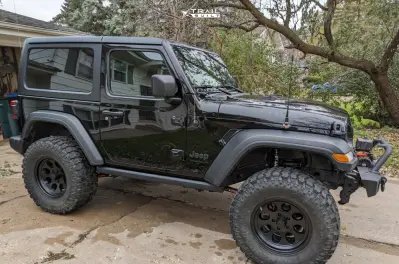
Jake learned his lesson. He sold the 35s for $800. Bought a set of 33-inch all-terrains. The difference was immediate. His Jeep drove like stock again. Fuel economy came back to 17. Transmission stopped hunting. He told me later, “I thought bigger tires were just about clearance. I didn't know they changed everything – gearing, acceleration, mpg, even braking distance.” That's the part that nobody puts in the Instagram captions. 35s look great. But they also add 30-50 pounds per corner. That unsprung weight affects suspension response. It increases stopping distance. It accelerates wear on ball joints, tie rods, and wheel bearings. It's not just a bolt-on upgrade. It's a system change. If you're considering 35s or 37s, here's what you need to check first. What's your current gear ratio? Look for the tag on the differential. Common ratios: 3.21, 3.45, 3.73, 4.10, 4.56. Multiply your ratio by your tire size change. A formula: New effective ratio = (Old tire diameter / New tire diameter) × Old gear ratio. If the result is below 3.50 on a Wrangler with 35s, you need a re-gear. What's your transmission? The automatic 8-speed can handle 35s with 3.73 gears. The older 5-speed needs 4.10 or higher. Manual transmissions need even deeper gears because they can't downshift automatically. What's your axle type? Dana 30 front and Dana 35 rear on older Jeeps won't survive 37s. You'll snap axle shafts. A Dana 44 is fine for 35s, marginal for 37s. A Dana 60 is for 40s. Jake's Jeep had a Dana 30 front and Dana 44 rear. The Dana 30 would have been fine with 35s, but the gearing killed the driving experience. He didn't need a re-gear for strength. He needed it for drivability. A lot of Jeep owners skip the math because they're excited. They see a picture of a lifted Wrangler on 35s and they want that exact look. They don't realize that Jeep might have 4.88 gears, a re-geared transfer case, aftermarket axles, and a hemi swap. The photo doesn't tell that story. Jake's story has a happy ending. He found a buyer for the 35s. He bought 33s. He's now saving for a proper re-gear to 4.56 so he can run 35s again – the right way. He told me, “Next time, I'm doing the math before I spend the money.” If you're upgrading tires on a truck or SUV, do the math first. Use the comparator. Use the gear ratio calculator. Then decide if the look is worth the trade-off.