"You'll get way better handling with the 19s," the guy said, leaning against the counter with the confidence of someone who had never read my owner's manual. "The 17s are fine for grandma, but you want something with grip. Something that looks good. The 19s fill out the wheel wells better." He smiled. I checked my phone. My 2019 Honda Accord owner's manual, page 372, said: "Recommended tire size: 215/55R17." I looked back at him. "My manual says 17s." He shrugged. "Manuals are conservative."
I'm Ryan Miller. I run tiresizehub.org from Detroit, Michigan, the city that built the American auto industry and still knows more about cars than the rest of the country combined. I built this site because I was tired of tire shops treating customers like wallets on wheels. This story is about the $800 upsell that almost worked — and the physics that prove why it shouldn't.
The tire shop's pitch was slick. They had a display of shiny 19-inch wheels with low-profile tires that looked like they belonged on a sports car. The price was "only" $200 more per tire than the 17s I needed. Plus installation. Plus alignment. Plus the extended warranty. Total additional cost: $847. For "better handling" on a Honda Accord that I drive to the grocery store.
Here's what the tire shop didn't tell me. Upsizing wheels — going from 17 to 19 inches — changes everything. The overall diameter of the tire must stay roughly the same to maintain speedometer accuracy and gear ratios. So when you increase the wheel diameter, you have to decrease the sidewall height. A 17-inch tire with a 55 aspect ratio has a sidewall of 4.7 inches. A 19-inch tire with a 45 aspect ratio has a sidewall of 3.8 inches. That's 19% less rubber between the wheel and the road.
Less sidewall means less cushioning. Every pothole, every expansion joint, every piece of gravel transmits more force directly to the wheel, the suspension, and your spine. The ride gets harsher. The wheels get more vulnerable to damage. And the tires wear faster because there's less rubber to absorb the wear. In Michigan, where our roads are maintained with what I can only describe as aggressive neglect, low-profile tires are a expensive hobby.
The handling claim was technically true but practically meaningless. A shorter sidewall does reduce tire flex during cornering, which improves steering response slightly. But on a Honda Accord — a front-wheel-drive family sedan with 192 horsepower — that improvement is imperceptible in normal driving. You would need to be on a racetrack, pushing the car to its absolute limit, to notice the difference. And if you're doing that on public roads, tire size is the least of your problems.
What I would notice, every day, was the reduced fuel economy. Bigger wheels are heavier. The 19-inch wheel and tire combination weighs about 5 pounds more per corner than the 17-inch setup. That's 20 pounds of unsprung weight — weight that the suspension has to manage with every bump. Unsprung weight is the enemy of efficiency. It takes more energy to accelerate, more energy to maintain speed, and more energy to stop. The EPA estimates that upsizing wheels by two inches can reduce fuel economy by 3-5%. On a car that gets 32 MPG, that's 1-1.6 MPG lost. Over 100,000 miles, that's 47-75 gallons of extra gas. At $3.50 a gallon, that's $165-263 in fuel costs alone.
The tire shop also didn't mention that 19-inch tires cost more to replace. A 215/55R17 touring tire runs about $120. A 235/40R19 performance tire runs about $180. That's $240 more per set, every 40,000-60,000 miles. Over the life of the car, assuming three sets of tires, that's $720 in additional tire costs. Plus the $847 upfront. Plus the fuel costs. The "only $200 more per tire" was actually a $1,700+ decision disguised as a minor upgrade.
I bought the 17s. The shop was visibly disappointed. The salesman tried one more time: "You sure? The 19s look way better." I told him my manual was sure. He rang up the 17s with the enthusiasm of a man who had just lost a commission. I drove home on tires that fit my car, rode comfortably, and didn't require me to avoid potholes like they were landmines.
The 2026 tire market is flooded with upsell pressure. Shops push bigger wheels, performance tires, and "premium" brands that offer marginal benefits at significant cost. Social media is full of cars with oversized wheels and stretched tires that look aggressive but perform worse and wear faster. The aesthetic has become the priority, and the engineering has been forgotten.
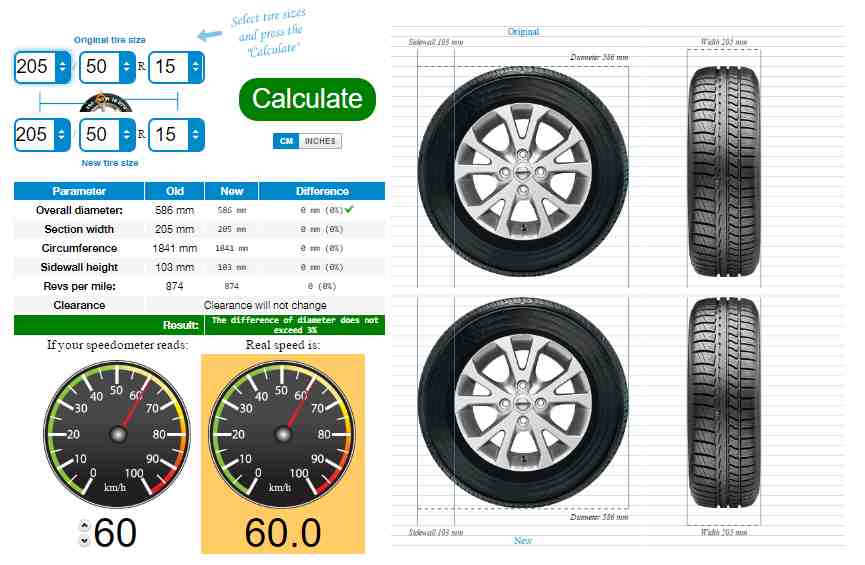
I built the tools on this site because I needed them. The tire size comparison shows you what changes when you upsize. The speedometer error calculator reveals the hidden cost of mismatched diameters. The cost of upsizing calculator adds up the lifetime expense. These tools don't tell you what looks good. They tell you what works. And sometimes, what works is the size that came from the factory.
If a tire shop is pushing bigger wheels, ask why. Ask about ride quality. Ask about fuel economy. Ask about replacement costs. And if they say "better handling," ask them to define "better" in the context of your actual driving. The answer might surprise you. Or it might just make them stop talking.
What size did your car's engineers actually design it for?
