Plus-Sizing Calculator
Enter your stock wheel size and desired new wheel size — see recommended tire sizes that keep diameter within 3% of stock.
All data stays in your browser — we never see it.
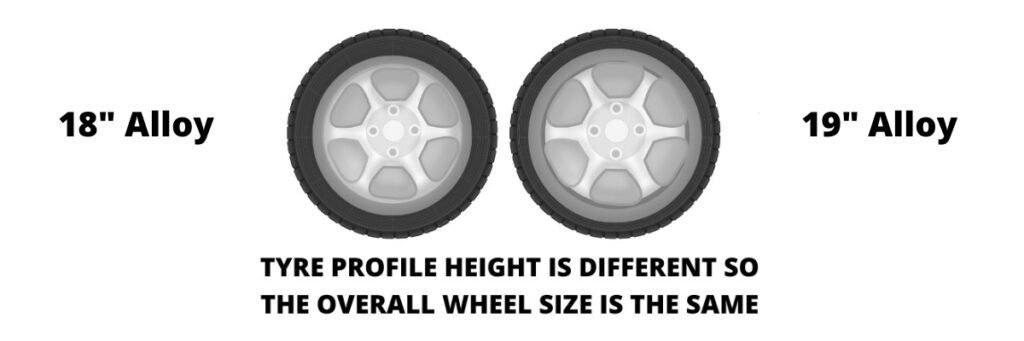
Here’s how it works. Enter your stock wheel diameter and tire size. Then enter your desired new wheel diameter. The calculator suggests tire sizes that keep the overall diameter within 3% of stock. It also shows the sidewall height difference and the speedometer error. For Alex’s Accord, the calculator recommended 235/40R19 or 225/40R19. Those have sidewall heights of about 3.7 inches – still lower than stock, but not as low as the 35-series tires he bought. The calculator also showed a speedometer error of less than 1% for the 235/40R19. He should have bought those. He didn’t. The Tire Size Comparator can help you visualize the difference between the recommended size and the size you’re considering.Tire Size Comparator
Compare two tire sizes side by side — see diameter, width, sidewall, and revs per mile.
All data stays in your browser — we never see it.
Alex compared his stock 215/55R17 to the recommended 235/40R19. The comparator showed the new tire was 20mm wider, about 0.4 inches taller in diameter, and had a sidewall that was 0.9 inches shorter. That’s a reasonable trade-off. He could have lived with that ride. Instead, he bought tires that were 1.4 inches shorter in sidewall – almost twice the reduction. The Load Index Calculator is also important when plus-sizing.Tire Load Index Calculator
Enter your tire size and load index — see maximum weight per tire and recommended load for your vehicle.
All data stays in your browser — we never see it.
When you go to a larger wheel, the load index of available tires might be lower. A 215/55R17 might have a load index of 94. A 235/40R19 might be 92. That’s acceptable – 92 is still 1,389 pounds per tire. But if your car needs a 94, don’t go lower. Check before you buy. Alex’s Accord needed a 91. The recommended 235/40R19 had a 92 – fine. The tires he actually bought had a 90 – too low. He was overloading them. That contributed to the pothole damage. The Tire Speed Rating Guide is another factor.Tire Speed Rating Guide
Enter your tire speed rating — see maximum safe speed and performance characteristics.
All data stays in your browser — we never see it.
A plus-size tire often has a higher speed rating – V or W instead of H. That’s fine. Going lower is a problem. Alex learned his lesson. He sold the 19-inch wheels and bought 18-inch wheels with 225/45R18 tires – sidewall about 3.9 inches. The ride was much better. He said “I wanted the look, but I didn’t want to hate driving my car.” That’s the balance. The plus-sizing calculator can also help you avoid rubbing. When you go to a larger wheel, the tire might be wider. Wider tires can rub on suspension components or fenders. The calculator doesn’t measure clearance, but it gives you the tire width. You can compare that to your stock width. If your stock tire is 215mm wide and you’re considering a 245mm wide tire, that’s a 30mm increase – about 1.2 inches. That extra width might cause rubbing, especially if you also change offset. Use the wheel offset calculator in combination with the plus-sizing calculator. I had a customer with a Volkswagen GTI. Stock tires were 225/40R18. He wanted 19-inch wheels. The plus-sizing calculator recommended 235/35R19 – 10mm wider. He checked his wheel wells. He had about 15mm of clearance. The 10mm increase was fine. He bought the wheels. No rubbing. Another customer, a guy with a BMW 3 Series, wanted 20-inch wheels. The calculator recommended 245/30R20. That’s a 20mm width increase over his stock 225 width. He measured his fenders. Not enough clearance. He stuck with 19-inch wheels. The plus-sizing calculator saved him from a costly mistake. The Tire Size Calculator is more general, but the plus-sizing calculator is more specific to wheel upgrades. Use the plus-sizing calculator first to find the recommended tire sizes. Then use the comparator to check sidewall height. Then use the load index calculator to check weight capacity. Then measure your clearances. Then buy. A lot of people skip the measurement step. They assume that if the calculator says it fits, it fits. The calculator says “within 3% of stock diameter.” That’s not a guarantee of clearance. You still need to measure. The Gear Ratio Calculator is less relevant for plus-sizing on a sedan, but on a truck, it matters.Gear Ratio Calculator
Enter your tire size, gear ratio, and transmission — see engine RPM at highway speed and recommended gear ratio for your tire size.
All data stays in your browser — we never see it.
If you’re plus-sizing a truck and increasing tire diameter by more than 5%, check your effective gear ratio. You might need a re-gear. Alex eventually sold the Accord and bought a Tesla. The Tesla came with 19-inch wheels from the factory. He didn’t have to worry about plus-sizing. He told me “I learned my lesson. Next time, I’ll just buy the car with the wheels I want.” That’s the smart move. Factory wheels are engineered for the car. Aftermarket wheels look better, but they come with trade-offs. More noise. Worse ride. Higher cost. More risk of rubbing. But if you’re set on plus-sizing, use the calculator. It’s free. It’s accurate. It will save you from buying the wrong tires.