Tire Size Calculator
Enter your tire size — see sidewall height, diameter, and revs per mile.
All data stays in your browser — we never see it.
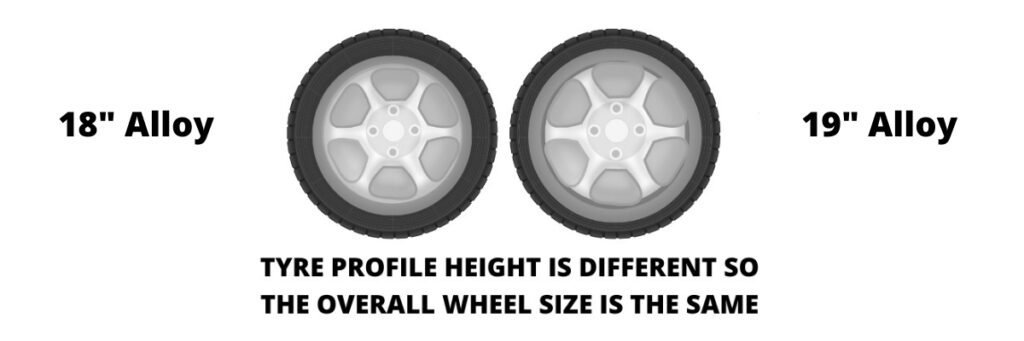
Take a common 19‑inch size: 225/40R19. Sidewall height: about 3.5 inches. The same car on 18‑inch wheels might run 225/45R18. Sidewall height: about 3.9 inches. That extra 0.4 inches of rubber makes a noticeable difference in ride comfort. It’s not huge, but you feel it. Take a bigger difference: a crossover on 20‑inch wheels vs 18‑inch wheels. 20s might run 245/45R20 – sidewall about 4.3 inches. 18s might run 235/60R18 – sidewall about 5.5 inches. That’s over an inch more rubber. That’s the difference between a car that crashes over bumps and one that glides. The Tire Size Comparator can help you compare sidewall heights directly.Tire Size Comparator
Compare two tire sizes side by side — see diameter, width, sidewall, and revs per mile.
All data stays in your browser — we never see it.
I had a customer with a Mazda CX‑5. The car came with 19‑inch wheels and 225/55R19 tires. Sidewall about 4.8 inches. He wanted more comfort. I suggested 17‑inch wheels from a lower trim. The 17‑inch size is 225/65R17 – sidewall about 5.7 inches. Almost an inch taller. The ride improved dramatically. He lost a tiny bit of cornering stability, but he drove like a normal person, not a race car driver. He was happy. The shift to 19‑inch wheels also affects tire cost. A 225/45R19 winter tire might cost $250 each. A 225/50R18 winter tire – same car, 18‑inch – might cost $180 each. That’s $280 saved on a set of four. Plus the wheels themselves are cheaper. Plus the tires last longer because there’s more rubber to wear. The Load Index Calculator is important when downsizing wheels.Tire Load Index Calculator
Enter your tire size and load index — see maximum weight per tire and recommended load for your vehicle.
All data stays in your browser — we never see it.
When you go from 19 to 18 inches, the load index often stays the same or increases slightly. But check. A 225/40R19 might have a load index of 92. A 225/45R18 might be 93. Both fine. A 225/50R17 might be 94. Higher is okay. Lower is not. So why do carmakers push 19s? Because they sell cars. A car on 19‑inch wheels looks better in the showroom. The test drive on smooth roads doesn’t reveal the harshness. By the time you live with the car for a few months, you’ve already signed the paperwork. I’m not saying 19s are bad. If you have smooth roads and you like a sporty feel, 19s are fine. But if you live in Michigan, Pennsylvania, Ohio, or any state with real potholes, 18s are smarter. They’re more durable. They’re cheaper. They ride better. A friend of mine, a guy named Pete, bought a used Audi A4 with 19‑inch wheels. He lived in Detroit. In one year, he bent two wheels on potholes. Repairs cost $400 each. He switched to 18‑inch wheels. No bent wheels since. He said “I should have done this the day I bought the car.” Here’s my advice for anyone shopping for a car or upgrading wheels. If you’re buying a new car, test drive both wheel sizes. Don’t just take the one on the showroom floor. Ask the dealer to let you drive a lower trim with smaller wheels. The ride difference might surprise you. If you already own a car with large wheels and you hate the ride, downsize. You can almost always go down one or two inches. Keep the overall tire diameter within 3% of stock. Use the tire size calculator to find the right size. If you’re buying aftermarket wheels, don’t go larger than 19 inches on a sedan unless you have very smooth roads. On a truck, 20s are okay because the tires have more sidewall anyway. On a compact car, 18s are the sweet spot. The BMW owner with the 19‑inch wheels kept his original wheels for summer use. He uses his 18‑inch wheels with all‑weather tires for fall through spring. Best of both worlds. That’s the smart move. Keep the big wheels for looks. Use smaller wheels for daily comfort.